







Modernizing Legacy Applications on AWS: Choosing Between Rehost, Replatform, Refactor, and Rebuild
Introduction
Migrating a legacy application to AWS is not the same as modernizing it.
An application can be moved successfully to the cloud while retaining the same architecture, operational limitations, technical debt, and deployment constraints it had on premises. Conversely, attempting to redesign every application during migration can significantly increase cost, complexity, and delivery risk.
For enterprise architects, the challenge is therefore not simply:
How do we move this application to AWS?
The more important question is:
How much modernization should we introduce now, and how much should we defer until after migration?
AWS defines seven common migration strategies—the 7 Rs: rehost, relocate, replatform, refactor or re-architect, repurchase, retain, and retire. For large migration programs, AWS guidance recommends balancing migration speed with modernization value and generally reserving deeper refactoring for workloads where the business case justifies the additional complexity.
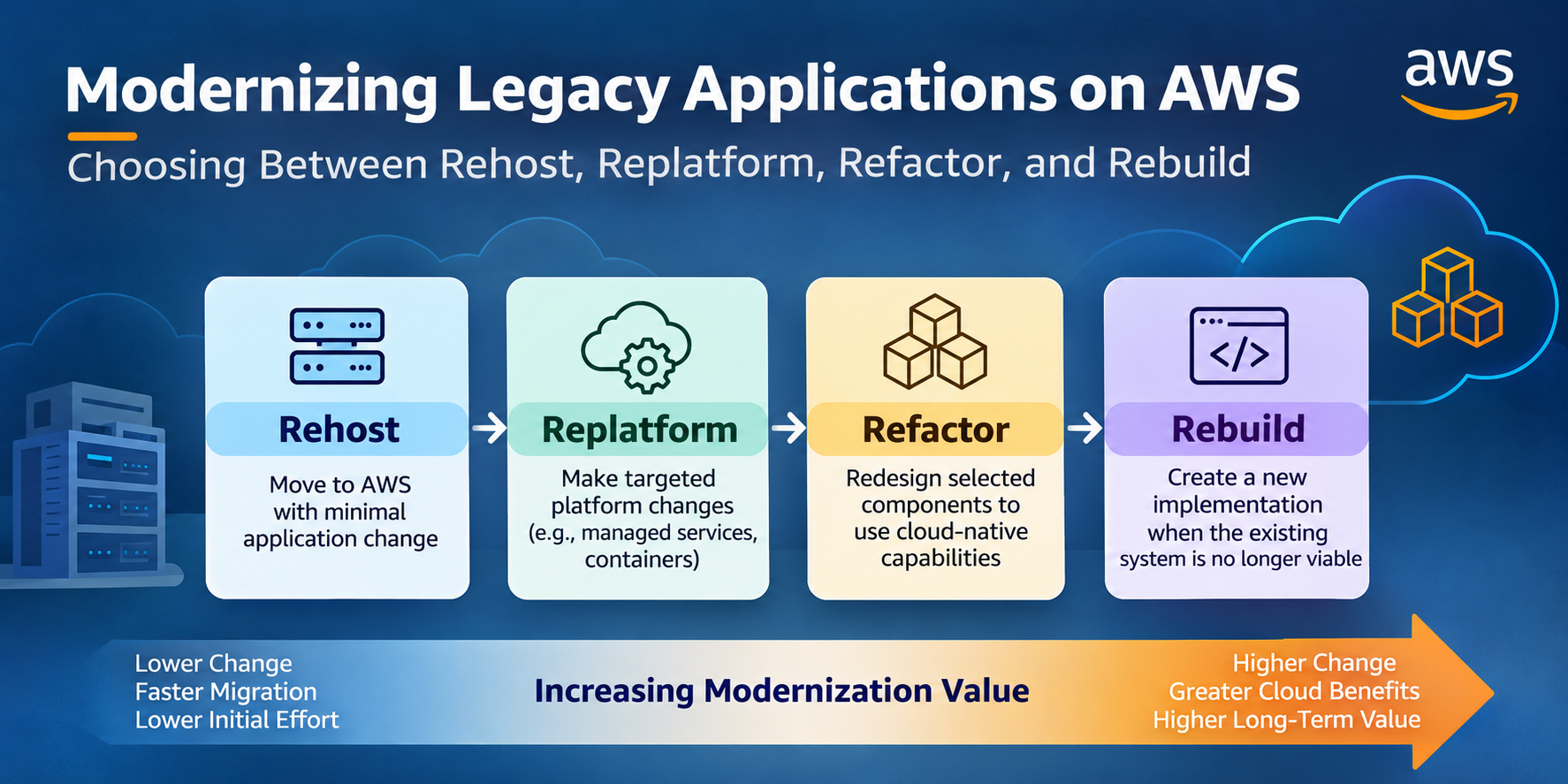
This article focuses on four approaches frequently considered when modernizing existing enterprise applications:
- Rehost — move with minimal application change
- Replatform — introduce targeted platform changes without fundamentally redesigning the application
- Refactor — redesign selected components or architectural patterns to take advantage of cloud-native capabilities
- Rebuild — create a substantially new implementation when preserving the existing application no longer makes sense
The objective is not to choose the strategy that appears the most cloud-native.
It is to choose the level of modernization that delivers the required business outcome with an acceptable balance of cost, risk, effort, time, and long-term value.
Executive Summary
Rehost for speed. Replatform for targeted cloud benefits. Refactor when the architecture itself is limiting business outcomes. Rebuild when preserving the existing implementation creates more long-term cost and risk than replacing it.
In enterprise modernization, the right answer is often not one strategy for an entire application. Different components may follow different paths depending on business value, technical condition, dependencies, and migration risk.
Decision in 60 Seconds
Choose Rehost when:
- Migration speed is the primary driver
- The application is stable
- Major code changes are not justified
- A data-center or platform exit deadline is driving the migration
- Application SMEs or development capacity are limited
Choose Replatform when:
- Managed AWS services can reduce operational overhead
- Targeted modernization can improve scalability, availability, or cost
- Significant application redesign is unnecessary
- The workload is suitable for containers or managed databases
Choose Refactor when:
- The existing architecture limits scalability, resilience, or delivery speed
- Application coupling slows business change
- Independent scaling or deployment is required
- The application is strategic enough to justify deeper engineering investment
Choose Rebuild when:
- The existing implementation is no longer economically or technically viable
- Technical debt is severe
- Business requirements have changed significantly
- Carrying the existing architecture forward provides little long-term value
And sometimes the correct answer is:
Do not modernize during migration.
When migration deadlines, poor test coverage, unclear dependencies, or limited application expertise create unacceptable change risk, moving first and modernizing later can be the stronger architecture decision.
Migration and Modernization Are Different Decisions
Migration primarily answers:
Where should the workload run?
Modernization answers:
How should the workload operate in its target environment?
For example, an application currently running on virtual machines could be:
Current Application
       │
       ├── Rehost ────────► Amazon EC2
       │
       ├── Replatform ────► Amazon ECS on AWS Fargate
       │
       ├── Refactor ──────► Containers + Serverless + Managed Services
       │
       └── Rebuild ───────► New Cloud-Native Application
All four approaches can result in the workload running on AWS.
However, their migration effort, architecture, operating model, risk, and potential business value are significantly different.
What Drives Application Modernization?
Modernization should begin with a reason.
Organizations rarely modernize simply because an application is old. They modernize because the current implementation prevents the business or technology organization from achieving an important outcome.
Common modernization drivers include:
Data-Center or Platform Exit
A data-center closure, hardware refresh, virtualization strategy change, or cloud-first initiative can create a fixed migration deadline.
In these cases, migration speed may take priority over deep modernization.
Unsupported Technology
Applications running on unsupported:
- Operating systems
- Databases
- Language runtimes
- Middleware
- Frameworks
can create security, supportability, compliance, and operational risks.
Modernization may be necessary simply to restore a sustainable technology baseline.
Operational Overhead
Legacy applications often require:
- Manual patching
- Manual scaling
- Manual failover
- Complex backup operations
- Server administration
- Capacity planning
Moving selected components to managed AWS services can remove much of this undifferentiated operational effort.
Scalability and Performance
Applications designed around fixed infrastructure may struggle with:
- Unpredictable demand
- Seasonal peaks
- Rapid growth
- Different scaling requirements across components
Modern architectures allow scaling to occur closer to the workload component that actually requires it.
Resilience Requirements
Existing architecture may no longer satisfy:
- Availability targets
- Recovery Time Objective (RTO)
- Recovery Point Objective (RPO)
- Multi-AZ requirements
- Disaster recovery expectations
Modernization may therefore be driven by resilience rather than application functionality.
Delivery Velocity
A tightly coupled application may require every component to be built, tested, and deployed together.
Modernization can introduce:
- Automated CI/CD
- Independent deployments
- Infrastructure as Code
- Smaller release units
- Faster rollback mechanisms
Cost
Legacy infrastructure can become expensive because of:
- Overprovisioned compute
- Commercial licensing
- Low utilization
- Manual operations
- Large support overhead
However, modernization decisions should consider total lifecycle cost, not compute charges alone.
Business Agility
The strongest modernization driver is often business change.
If the existing architecture prevents teams from launching products, integrating partners, entering markets, or delivering customer features quickly enough, deeper modernization may be justified.
Modernization Spectrum
The four strategies can be viewed as a continuum.
Lower Change                                                Higher Change
Lower Immediate Effort                                Higher Immediate Effort
        │                                                       │
        ▼                                                       ▼

   REHOST  ──────►  REPLATFORM  ──────►  REFACTOR  ──────►  REBUILD

 Move largely       Optimize selected     Change the        Create a
 as-is              platform components   architecture      new implementation

        │                                                       │
        └──────────── Increasing modernization potential ───────┘
Moving from left to right generally increases:
- Application change
- Engineering effort
- Testing requirements
- Migration complexity
- Organizational impact
But it can also increase:
- Technical debt reduction
- Operational improvement
- Architectural flexibility
- Long-term modernization value
The objective is not to move as far right as possible.
The correct position depends on the workload.
Assess Before Choosing a Modernization Strategy
The modernization decision should begin with the application and its business context, not with a preferred AWS service.
Business Criticality
Understand:
- Revenue impact
- Customer impact
- Regulatory importance
- Operational dependency
- Strategic importance
A low-value internal application may not justify significant engineering investment, while a strategic customer-facing platform may.
Expected Application Lifespan
Ask:
- Is this application expected to remain strategic for five or more years?
- Is it scheduled for replacement?
- Is it already in maintenance mode?
- Is another platform being developed?
Deep modernization has little value if the workload will soon be retired.
Technical Debt
Assess:
- Unsupported operating systems
- Legacy frameworks
- Tight coupling
- Hard-coded configuration
- Manual deployments
- Limited automated testing
- Poor observability
- Undocumented dependencies
Technical debt does not automatically mean rebuild.
The question is whether eliminating that debt delivers sufficient business value.
Architecture and Dependencies
Map:
- Application components
- Databases
- File systems
- APIs
- Batch processes
- Authentication systems
- Messaging platforms
- External integrations
- Network dependencies
Many migration problems occur because teams assess servers but overlook application dependencies.
Operational Characteristics
Review:
- CPU and memory utilization
- Peak traffic patterns
- Scaling requirements
- Availability requirements
- RTO and RPO
- Backup model
- Deployment frequency
- Incident history
This helps determine whether the architecture is simply old or genuinely preventing the required outcomes.
Organizational Readiness
Modernization depends on people as much as technology.
Evaluate:
- Application-owner availability
- Development capacity
- AWS skills
- Container and serverless experience
- Automated testing maturity
- CI/CD maturity
- Platform engineering capability
A technically ideal target architecture can still fail if the organization cannot sustainably operate it.
Rehost: Move First, Modernize Later
Rehosting—commonly called lift and shift—moves an application to AWS with minimal architectural change.
A common target is:
On-Premises VM
      │
      ▼
 Amazon EC2
When Rehost Makes Sense
Choose rehost when:
- A data-center exit deadline is approaching
- Application changes introduce unacceptable risk
- Source code is unavailable
- Development capacity is limited
- The application is stable and mature
- The immediate objective is migration
- Modernization is planned as a later phase
- A large portfolio must move quickly
Benefits
- Fast migration path
- Minimal application change
- Lower initial migration complexity
- Familiar operating model
- Easier migration-wave planning
Limitations
Rehosting can also carry existing limitations into AWS:
- Manual scaling
- Server patching
- Legacy deployment processes
- Application coupling
- Existing licensing costs
- Low resource utilization
- Limited cloud-native resilience
Rehosting should therefore be treated as a migration strategy, not automatically as the final-state architecture.
Architectural takeaway
Rehost when migration speed and change minimization matter more than immediate modernization.
Replatform: Target the Highest-Value Improvements
Replatforming introduces targeted modernization without fundamentally redesigning the application.
Examples include:
Self-Managed PostgreSQL
          │
          ▼
 Amazon RDS / Aurora
or:
Application on VMs
        │
        ▼
    Container
        │
        ▼
Amazon ECS on AWS Fargate
or:
Local File Storage
        │
        ▼
     Amazon S3
When Replatform Makes Sense
Choose replatform when:
- Managed services can reduce operational overhead
- Existing application logic can largely remain unchanged
- Databases can move to managed platforms
- Containerization is practical
- Manual scaling or patching should be reduced
- Migration can tolerate limited application change
Common Replatforming Patterns
Database Modernization
Potential transitions include:
- PostgreSQL → Amazon RDS for PostgreSQL
- PostgreSQL → Amazon Aurora PostgreSQL-Compatible Edition
- SQL Server → Amazon RDS for SQL Server
- Self-managed Redis → Amazon ElastiCache
The objective is often to reduce database administration while improving backup, availability, patching, and scaling capabilities.
Containerization
Traditional application processes can sometimes be containerized and deployed to:
- Amazon ECS
- AWS Fargate
- Amazon EKS where Kubernetes is explicitly required
Storage Modernization
Common transitions include:
- Local object-like content → Amazon S3
- Shared NFS storage → Amazon EFS
- Windows file shares → Amazon FSx
The target should be selected based on actual application access patterns rather than simply replacing one file system with another.
Operational Modernization
Even if application code remains largely unchanged, teams can introduce:
- Infrastructure as Code
- CI/CD pipelines
- Auto Scaling
- Centralized logging
- Managed backup
- Secrets management
- Automated patching
These changes can create meaningful operational improvement without requiring a full redesign.
Architectural takeaway
Replatform when a limited number of targeted changes can remove significant operational burden or cost.
For many enterprise workloads, replatforming provides the strongest balance between modernization value and migration risk.
Refactor: Change the Architecture to Change the Outcome
Refactoring—or re-architecting—changes application design so that the workload can take greater advantage of cloud-native capabilities.
A traditional monolithic application might evolve from:
Web + Business Logic + Batch Processing
              │
              ▼
       Single Application
              │
              ▼
          Database
to:
       API Gateway / Load Balancer
                  │
          ┌───────┼────────┐
          │       │        │
          ▼       ▼        ▼
      Container  Lambda   Worker
       Service  Function  Service
          │       │        │
          └───────┼────────┘
                  ▼
          Messaging / Events
                  │
                  ▼
          Managed Data Services
When Refactoring Makes Sense
Consider refactoring when:
- The monolith limits release velocity
- Components require independent scaling
- Availability requirements cannot be met efficiently
- Tight coupling prevents frequent changes
- Business growth requires faster feature delivery
- The application is strategically important
- The expected application lifespan justifies the investment
Common Refactoring Patterns
Extract High-Value Components
Do not assume the entire monolith must immediately become microservices.
Start with components that have clear boundaries, such as:
- Notification processing
- Document processing
- Reporting
- Scheduled jobs
- Image processing
- Authentication integration
Replace Synchronous Coupling with Messaging
For example:
Application
    │
    ▼
SQS / EventBridge
    │
    ▼
Worker / Lambda
This can improve decoupling and resilience.
Modernize Scheduled Work
For example:
Cron Jobs
   │
   ▼
EventBridge Scheduler
   │
   ▼
Lambda / ECS Task / Step Functions
Modernize Data Access Carefully
Database decomposition is often harder than application decomposition.
Potential approaches include:
- Separate data ownership by domain
- Gradual schema separation
- Read replicas for reporting
- Caching through Amazon ElastiCache
- Event-driven synchronization
Do not split a database simply because application components have been separated.
Architectural takeaway
Refactor when the existing architecture itself is preventing important business or technical outcomes.
Rebuild: When Carrying the Existing Architecture Forward No Longer Makes Sense
Rebuild is not a separate strategy in AWS’s official 7 Rs model.
AWS uses refactor/re-architect for substantial application redesign. In this article, rebuild is used as a practical enterprise distinction for situations where an organization creates a substantially new implementation rather than incrementally modifying the existing one.
The distinction matters because the engineering, testing, migration, and organizational implications of rebuilding an application can be materially different from selectively refactoring it.
Rebuild May Be Appropriate When
- The technology stack is unsupported
- Source code quality is extremely poor
- Application knowledge has been lost
- Business requirements have changed significantly
- Technical debt dominates engineering effort
- The existing application cannot meet future requirements
- Incremental modernization approaches the cost of replacement
Rebuild Does Not Mean “Rewrite Everything”
A rebuild should begin with business capabilities, not the old codebase.
Ask:
- Which capabilities are still required?
- Which functions can be retired?
- Which could use SaaS?
- Which can use managed AWS services?
- Which actually require custom development?
A successful rebuild may produce a much smaller system than the application it replaces.
Architectural takeaway
Rebuild when preserving the existing implementation creates more long-term cost and risk than replacing it.
Enterprise Modernization Decision Framework
The strategy should balance business value, application lifespan, modernization benefit, and change complexity.
| Decision Factor | Rehost | Replatform | Refactor | Rebuild |
|---|---|---|---|---|
| Migration speed | Highest | High | Low | Lowest |
| Application change | Minimal | Limited | Significant | Very high |
| Initial migration risk | Lowest | Low–medium | High | High |
| Cloud optimization | Low | Medium–high | High | Highest |
| Development effort | Low | Medium | High | Highest |
| Application-team involvement | Low | Medium | High | Very high |
| Technical debt reduction | Low | Medium | High | Highest |
| Operational improvement | Low–medium | High | High | High |
| Strategic business value required | Low | Medium | High | High |
| Expected application lifespan | Short–long | Medium–long | Long | Long |
| Testing maturity required | Low–medium | Medium | High | High |
| Organizational change | Low | Medium | High | Highest |
| Best fit | Fast migration | Targeted modernization | Strategic applications | Obsolete implementation |
| Typical timing | During migration | During migration | Often phased | Separate transformation program |
This matrix should not be applied mechanically.
Business priorities, dependencies, compliance constraints, timelines, and organizational readiness should override generic rankings.
Architecture Decision Tree
Start with the application
          │
          ▼
Is the application still required?
          │
     ┌────┴────┐
     │         │
    No        Yes
     │         │
     ▼         ▼
  Retire     Is rapid migration the
             dominant requirement?
                  │
             ┌────┴────┐
             │         │
            Yes        No
             │         │
             ▼         ▼
       Can it move      Can targeted platform changes
       largely as-is?   deliver the required outcome?
             │                    │
        ┌────┴────┐          ┌────┴────┐
        │         │          │         │
       Yes        No        Yes        No
        │         │          │         │
        ▼         ▼          ▼         ▼
     Rehost    Evaluate   Replatform   Is the existing
               Replatform              architecture worth
                                       preserving?
                                            │
                                       ┌────┴────┐
                                       │         │
                                      Yes        No
                                       │         │
                                       ▼         ▼
                                    Refactor   Rebuild
Before finalizing the strategy, validate:
- Business criticality
- Application lifespan
- Dependencies
- RTO and RPO
- Licensing
- Security and compliance
- Team availability
- Test automation
- Cost
- Migration deadline
Modernization Is Often Component-Level, Not Application-Level
A single application can—and often should—use more than one modernization strategy.
Do not force the entire workload into a single classification simply because migration planning requires a high-level strategy.
For example:
                Existing Application
                         │
        ┌────────────────┼─────────────────┐
        │                │                 │
        ▼                ▼                 ▼
     Web Tier         Database         Batch Jobs
        │                │                 │
        ▼                ▼                 ▼
   Replatform        Replatform          Refactor
        │                │                 │
        ▼                ▼                 ▼
 ECS Fargate      Amazon Aurora    EventBridge + Lambda

        Existing File Storage       Legacy Module
                 │                       │
                 ▼                       ▼
            Replatform                Rehost
                 │                       │
                 ▼                       ▼
             Amazon S3              Amazon EC2
This component-level approach often provides a better balance between modernization value and delivery risk.
It also allows teams to modernize where the benefit is clear while avoiding unnecessary change in stable components.
Think at Portfolio Level, Not Only Application Level
Enterprise modernization typically involves hundreds or thousands of workloads.
The question therefore becomes not only:
What should we do with this application?
but also:
Which applications should move together, and which should be modernized first?
A portfolio can be grouped using:
- Business criticality
- Application dependencies
- Migration readiness
- Technical complexity
- Migration strategy
- Infrastructure dependencies
- Data dependencies
- Application-owner availability
- Regulatory requirements
- Modernization potential
A simplified approach might look like:
Application Portfolio
        │
        ▼
Assess and Rationalize
        │
        ├── Wave 1 → Low-complexity Rehost / Replatform
        │
        ├── Wave 2 → Business-critical Replatform
        │
        ├── Wave 3 → Strategic Refactoring
        │
        └── Transformation Program → Rebuild Candidates
This prevents a small number of complex modernization projects from blocking movement of the wider portfolio.
Security and Governance Must Travel with the Workload
Modernization changes architecture, but it should not weaken enterprise controls.
Throughout rehost, replatform, refactor, or rebuild activities, teams should continue to validate:
- IAM and least-privilege access
- Network segmentation
- Encryption
- Logging and monitoring
- Backup and recovery
- Vulnerability management
- Secrets management
- Compliance requirements
- Resilience controls
As applications move toward containers, serverless, event-driven services, and managed data platforms, controls may need to be implemented differently—but the underlying governance requirements remain.
Modernization should change how controls are implemented, not whether they exist.
When Not to Modernize During Migration
Modernization during migration is not always the right decision.
Avoid combining significant modernization with migration when:
- A hard data-center exit deadline exists
- Test coverage is poor
- Application SMEs are unavailable
- Dependencies are poorly understood
- Business requirements are actively changing
- The application will soon be retired
- The organization lacks experience with the target platform
- Application change materially increases cutover risk
This leads to an important architecture principle:
Migration and modernization do not have to happen at the same time.
Phased Modernization: A Practical Enterprise Approach
For many organizations, modernization works best as a progression.
Phase 1 — Assess
Understand:
- Business value
- Current architecture
- Dependencies
- Costs
- Performance
- Technical debt
- Migration constraints
Phase 2 — Migrate
Choose the lowest-risk strategy capable of meeting immediate objectives.
Examples:
- Rehost critical legacy servers
- Replatform databases
- Containerize suitable application tiers
Phase 3 — Stabilize
After migration:
- Establish operational baselines
- Validate performance
- Verify monitoring
- Test backup and recovery
- Tune scaling
- Validate cost assumptions
Phase 4 — Modernize
Modernize components where the business case is strongest.
Examples:
- Replace cron jobs with managed scheduling
- Move file processing to event-driven services
- Introduce containers
- Decouple workloads with messaging
- Modernize database platforms
- Introduce independent deployment patterns
Phase 5 — Optimize
Continue improving:
- Cost
- Performance
- Reliability
- Security
- Deployment velocity
- Operational automation
- Developer experience
This approach separates migration risk from transformation risk.
AWS Services Across the Modernization Journey
The target architecture depends on the workload.
| Capability | Common AWS Services | Typical Modernization Use |
|---|---|---|
| Compute | Amazon EC2, Amazon ECS, AWS Fargate, Amazon EKS, AWS Lambda | Rehost servers, containerize applications, introduce serverless execution |
| Databases | Amazon RDS, Amazon Aurora, Amazon DynamoDB, Amazon ElastiCache | Reduce database administration, improve availability and scalability |
| Storage | Amazon S3, Amazon EFS, Amazon FSx | Replace local or self-managed storage with managed storage services |
| Integration | Amazon SQS, Amazon SNS, Amazon EventBridge, AWS Step Functions | Decouple components and introduce asynchronous or event-driven processing |
| Operations | Amazon CloudWatch, AWS Systems Manager, AWS Backup, AWS Secrets Manager | Improve monitoring, automation, backup, configuration, and secrets handling |
| Infrastructure Automation | AWS CloudFormation, AWS CDK, Terraform | Standardize and automate infrastructure provisioning |
The modernization strategy should determine which services are appropriate.
Do not select the AWS service first and then redesign the workload to justify it.
Where AWS Transform Fits
Automation and AI-assisted assessment can accelerate modernization planning, but they do not replace architectural judgment.
AWS Transform can help analyze discovered infrastructure and provide migration-strategy recommendations and target-state guidance for supported workloads.
It can also assist selected replatforming and modernization scenarios, including identifying opportunities to move workloads toward more modern infrastructure models.
These capabilities are useful for accelerating:
- Discovery
- Assessment
- Migration-strategy recommendations
- Target-state analysis
- Modernization opportunity identification
However, automated recommendations should remain decision support.
Architects must still evaluate:
- Business importance
- Application dependencies
- Licensing
- Compliance
- Target operating model
- Team capability
- Testing maturity
- Long-term application roadmap
Automation can accelerate analysis.
It should not replace the business context behind the architecture decision.
Measuring Modernization Outcomes
A modernization program should not be considered successful simply because the target architecture uses more managed or cloud-native services.
Success should be measured against the outcomes that justified modernization.
| Outcome | Example Measures |
|---|---|
| Delivery velocity | Deployment frequency, lead time for change |
| Reliability | Availability, incident rate, failed deployments |
| Recovery | Recovery time, recovery point achievement |
| Operations | Manual operational effort, patching effort, support hours |
| Scalability | Time to scale, ability to handle peak demand |
| Cost | Infrastructure cost, licensing cost, operational cost |
| Engineering productivity | Build time, deployment time, environment provisioning time |
| Technical debt | Unsupported components removed, legacy dependencies reduced |
Not every modernization initiative needs every metric.
The important principle is:
Define the expected outcome before modernization and measure whether the architecture actually delivered it.
Otherwise, modernization risks becoming technology change without measurable business value.
Real-World Enterprise Scenarios
Scenario 1 — Data-Center Exit with a Fixed Deadline
An organization must exit its data center within six months. Several stable applications still provide business value but have limited development capacity.
Recommended strategy
Primarily Rehost
Move applications to Amazon EC2 with minimal change and evaluate deeper modernization after migration.
Why?
Migration speed and risk reduction are more important than immediate architectural optimization.
Scenario 2 — Traditional Three-Tier Application
A web application runs on virtual machines with PostgreSQL and shared file storage.
The application itself is stable, but server administration and database maintenance create significant operational overhead.
Recommended strategy
Replatform
Potential architecture:
Web / Application Tier ─────► Amazon ECS on AWS Fargate

Database ───────────────────► Amazon Aurora PostgreSQL

File Storage ───────────────► Amazon S3 / Amazon EFSWhy?
Significant operational improvements can be achieved without redesigning the application’s core business logic.
Scenario 3 — Monolith Limiting Business Agility
A strategic customer platform has long release cycles because every module must be built, tested, and deployed together.
Individual components also experience very different scaling patterns.
Recommended strategy
Selective Refactoring
Start with clearly bounded functions such as:
- Notifications
- Document processing
- Background jobs
- Reporting
Do not immediately decompose every business function into microservices.
Why?
The architecture itself is limiting business agility.
Scenario 4 — Obsolete Internal Platform
An internal application is built on unsupported frameworks, has limited documentation, poor test coverage, and significant operational cost.
Business processes have also changed substantially since it was developed.
Recommended strategy
Rebuild—or evaluate Repurchase
Start with current business requirements rather than recreating the old application feature-for-feature.
Why?
Preserving the existing implementation provides little long-term value.
Common Modernization Mistakes
Modernizing Everything During Migration
This increases delivery risk and can delay movement of the wider application portfolio.
Rehosting Everything Permanently
This moves technical debt to AWS without realizing enough cloud value.
Choosing AWS Services Before Assessing the Workload
Architecture becomes driven by technology preference rather than business requirements.
Breaking Every Monolith into Microservices
Microservices introduce their own operational and distributed-system complexity. Decompose only where the business or scaling model justifies it.
Ignoring Application Dependencies
Applications rarely operate independently. Missing dependencies can create unexpected cutover failures.
Modernizing Without Adequate Testing
Without sufficient test coverage, teams cannot easily distinguish migration defects from modernization defects.
Comparing Only Infrastructure Cost
Engineering effort, licenses, platform operations, support effort, and developer productivity all contribute to total ownership cost.
Applying One Strategy Across the Portfolio
Different applications—and often different components within an application—require different treatments.
Treating Modernization as a One-Time Project
Applications continue to evolve. Modernization decisions should be revisited as business requirements, AWS capabilities, costs, and technology constraints change.
Enterprise Modernization Principles
- Start with business outcomes, not AWS services.
- Assess application components individually where it creates better decisions.
- Choose the least disruptive strategy capable of meeting the required outcome.
- Do not combine migration and deep modernization unless the business case justifies the additional risk.
- Prioritize strategic, long-lived applications for deeper modernization.
- Use managed services where they meaningfully reduce operational burden.
- Treat technical debt reduction as an investment decision, not an automatic migration requirement.
- Validate the target architecture against team capability, testing maturity, and the future operating model.
- Plan modernization across the portfolio using dependencies and migration waves—not one application at a time in isolation.
- Preserve security, governance, resilience, and compliance controls throughout the modernization journey.
- Define measurable outcomes before modernization begins.
- Document significant architecture decisions using Architecture Decision Records and define when those decisions should be reassessed.
Conclusion
Modernizing legacy applications on AWS is not about moving every workload to containers, serverless architectures, microservices, or the newest managed service.
The right strategy depends on the application’s:
- Business value
- Technical condition
- Expected lifespan
- Migration timeline
- Dependencies
- Operational requirements
- Organizational readiness
Rehost provides speed and minimizes application change.
Replatform introduces targeted cloud improvements without requiring a complete redesign.
Refactor changes the architecture when existing constraints are preventing meaningful business or technical outcomes.
Rebuild becomes appropriate when preserving the existing implementation creates more long-term cost and risk than replacing it.
For many enterprises, modernization is not a single transformation event.
It is a progression:
Assess → Migrate → Stabilize → Modernize → Optimize
And different applications—or even different components of the same application—may move through that journey differently.
The goal is not to create the most cloud-native architecture possible.
The goal is to introduce the right amount of modernization, at the right time, for the right business outcome—and to measure the value it delivers.
Ready to Modernize Your AWS Application Portfolio?
A successful modernization program starts with understanding which applications should move as-is, which should adopt targeted cloud services, and which justify deeper architectural transformation.
QloudX can help organizations assess application portfolios, define migration and modernization strategies, design target AWS architectures, and build phased modernization roadmaps aligned with business priorities, technical constraints, and operational readiness.
 Linkedin