






Choosing Between AWS Lambda, Amazon ECS on AWS Fargate, and Amazon EKS: An Enterprise Decision Framework

Introduction
Choosing a compute platform is one of the most consequential architecture decisions in an AWS environment. The selected platform influences application design, scalability, resilience, deployment velocity, portability, operational ownership, governance, and long-term cost.
AWS Lambda, Amazon Elastic Container Service running on AWS Fargate, and Amazon Elastic Kubernetes Service can all support modern applications, but they represent fundamentally different operating models:
- AWS Lambda provides function-based, event-driven execution.
- Amazon ECS on AWS Fargate provides AWS-native container orchestration without requiring teams to manage worker nodes.
- Amazon EKS provides managed Kubernetes orchestration with access to Kubernetes APIs, tooling, and extensibility.
The correct choice is rarely determined by one factor such as cost, container support, or scalability. Enterprises must consider workload behavior, runtime requirements, availability, networking, governance, team maturity, and the level of operational responsibility the organization is prepared to own.
This article provides a practical framework for selecting the appropriate platform for each workload—and explains why many enterprises ultimately use all three workload—and explains why many enterprises ultimately use all three.
Decision in 60 Seconds
- Choose AWS Lambda for stateless, event-driven workloads that fit the Lambda execution model.
- Choose Amazon ECS on AWS Fargate for long-running containerized services when Kubernetes is not a requirement.
- Choose Amazon EKS when Kubernetes APIs, ecosystem tooling, extensibility, or organizational standardization provide clear value.
- Use a hybrid model when different workload types have different runtime and operational needs.
The best platform is not the one with the most features. It is the least complex platform that meets the workload’s functional, operational, resilience, and governance requirements.
Scope note: This guide focuses on standard Lambda functions, Amazon ECS running on AWS Fargate, and Amazon EKS using EC2-based capacity or EKS Auto Mode. EKS can also run Kubernetes pods on Fargate. Lambda Durable Functions and Lambda Managed Instances extend Lambda for durable workflows and EC2-backed execution, respectively, but do not remove the fundamental distinction between functions, container services, and Kubernetes orchestration.
The Three Compute Models at a Glance
| Platform | Primary execution model | Typical workload fit | Operational profile |
| AWS Lambda | Event-triggered function | Events, automation, short API processing, asynchronous tasks | Lowest infrastructure overhead |
| ECS on Fargate | Container task or service | APIs, microservices, workers, long-running applications | Managed containers without node operations |
| Amazon EKS | Kubernetes workload | Shared Kubernetes platforms, complex container estates, advanced orchestration | Highest flexibility and platform responsibility |
AWS Lambda
Lambda runs code in response to events without requiring teams to provision or manage servers. It is particularly suited to stateless, independently executable units of work. Standard Lambda invocations can run for up to 15 minutes and scale by provisioning execution environments as concurrency increases.
Typical use cases include:
- S3 file processing
- SQS and EventBridge consumers
- API request handlers
- Stream processing
- Scheduled automation
- Operational remediation
Lambda is not simply a smaller container platform. Its invocation model, lifecycle, scaling behavior, and runtime constraints influence how applications must be designed.
Amazon ECS on AWS Fargate
Amazon ECS is AWS’s native container orchestration service. AWS Fargate supplies the compute capacity required to run ECS tasks without teams provisioning or maintaining EC2 worker nodes.
Teams package applications as containers, define CPU, memory, IAM, networking, and scaling requirements, and run them as long-lived services or one-time tasks.
Typical use cases include:
- Web applications and APIs
- Java and .NET services
- Background workers
- Queue consumers
- Scheduled container jobs
- Applications modernized from virtual machines
ECS on Fargate provides container flexibility without introducing the Kubernetes control plane and ecosystem.
Amazon EKS
Amazon EKS is AWS’s managed Kubernetes service. AWS manages the Kubernetes control plane, while customers deploy and govern workloads using Kubernetes resources and APIs.
EKS Auto Mode reduces infrastructure-management effort by managing capabilities such as compute scaling, pod and service networking, load-balancer integration, block storage, and selected node lifecycle activities. Teams still remain responsible for application architecture, Kubernetes resources, policy, observability, and platform governance.
Typical use cases include:
- Large Kubernetes estates
- Multi-team internal developer platforms
- Applications using operators or custom resources
- Advanced scheduling requirements
- Service-mesh-based architectures
- GitOps-driven platforms
- Workloads migrating from Kubernetes or OpenShift
Why the Decision Is More Complex Than Serverless vs Containers
A simplified decision model might suggest:
- Lambda for serverless
- ECS on Fargate for containers
- EKS for Kubernetes
While directionally correct, that approach is not sufficient for an enterprise architecture decision.
A platform can be technically capable of running a workload while still being unsuitable for the team expected to operate it. The decision should therefore be evaluated across five broader dimensions:
- Workload and runtime fit
- Scaling, resilience, and release requirements
- Networking and service integration
- Operating model, team maturity, and governance
- Portability and long-term platform strategy
The Enterprise Decision Framework
1. Workload and Runtime Fit
Start with how the workload behaves—not with a preferred AWS service.
Choose a function-oriented model when the workload is:
- Triggered by an event
- Stateless between invocations
- Independently executable
- Bursty or intermittent
- Short-lived under the standard execution model
- Closely integrated with managed AWS services
These characteristics generally point toward Lambda.
Choose a continuously running container model when the workload:
- Exposes an always-available API
- Maintains persistent network connections
- Uses in-memory caches or connection pools
- Runs long-lived workers
- Requires custom runtime or operating-system packages
- Is already packaged as a conventional OCI container
These characteristics generally point toward ECS on Fargate or EKS.
Choose Kubernetes when the workload or organization requires:
- Kubernetes operators or custom resources
- DaemonSets
- Advanced workload scheduling
- Kubernetes-native policy engines
- Service meshes
- Kubernetes-based GitOps
- A shared Kubernetes platform across teams or environments
The central question is not whether the application uses a container. Both ECS and EKS run containers, while Lambda also supports container images as a packaging format within the Lambda execution model.
The better question is:
Does this workload or organization specifically require Kubernetes?
2. Scaling, Resilience, and Release Requirements
Scaling must be evaluated together with availability and deployment behavior.
Lambda
Lambda is well suited to bursty event volumes because it provisions additional execution environments as concurrency increases.
Architects must still manage:
- Concurrency quotas
- Retry behavior
- Event backlogs
- Startup latency
- Downstream-service capacity
- Idempotency and failure handling
Reserved concurrency can both allocate concurrency to a function and cap its maximum scale, helping prevent it from overwhelming downstream systems. Provisioned concurrency pre-initializes execution environments when predictable startup performance is required.
Lambda resilience also depends on event-source configuration, retry policies, dead-letter handling, downstream availability, and version or alias deployment strategies.
ECS on Fargate
ECS services scale by adjusting the number of running tasks. Scaling can use CPU, memory, load-balancer request count, schedules, or supported custom metrics.
ECS supports:
- Multi-AZ task placement
- Load-balancer health checks
- Rolling deployments
- Blue/green deployment patterns
- Deployment rollback controls
- Scheduled and target-tracking scaling
Container startup and load-balancer registration are slower than Lambda invocation scaling, so scaling policies should be based on realistic workload testing.
Amazon EKS
EKS usually scales at two levels:
- Pods, through Kubernetes workload autoscaling.
- Nodes, through managed node groups, Karpenter, EKS Auto Mode, or another capacity model.
EKS also supports advanced release and resilience controls such as:
- Rolling, canary, and blue/green strategies
- Pod disruption budgets
- Topology-spread constraints
- Anti-affinity rules
- Multiple ingress models
- Service meshes
This provides extensive flexibility, but teams must correctly coordinate pod requests, autoscaling, node capacity, disruption controls, and deployment policies.
The most flexible platform is not automatically the most resilient. Resilience depends on how effectively the organization configures and operates it.
3. Networking and Service Integration
Lambda is a strong fit when:
- Managed AWS integrations handle most event routing
- API Gateway, EventBridge, SQS, or S3 are primary entry points
- Optional VPC access is sufficient for private resources
- Per-container or pod-level networking is unnecessary
ECS on Fargate is a strong fit when:
- Tasks require direct VPC connectivity
- Task-level security groups are needed
- ALB or NLB integration is required
- Applications use long-lived connections
- Teams require direct subnet and routing control
Each Fargate task receives its own elastic network interface, enabling granular VPC routing, security-group control, and network monitoring.
EKS is a strong fit when:
- Kubernetes NetworkPolicies are required
- Pod-level service discovery is important
- Ingress controllers or service meshes are used
- Namespace-level segmentation is required
- Advanced east-west traffic management is needed
EKS offers the greatest networking flexibility, but also the largest networking and troubleshooting surface.
4. Operating Model, Team Maturity, and Governance
The platform must align with the organization expected to operate it.
Lambda
AWS manages the underlying compute, operating system, execution-environment lifecycle, and runtime scaling.
Application teams remain responsible for:
- Function code
- IAM permissions
- Event configuration
- Concurrency and retries
- Observability
- Downstream-service protection
Lambda usually has the lowest infrastructure-management burden, although large function estates still require standards for ownership, deployment, runtime upgrades, logging, and shared components.
ECS on Fargate
AWS manages the underlying compute capacity and host operating systems.
Application teams manage:
- Container images
- Task definitions
- Services
- Load balancing
- Scaling
- IAM roles
- Deployment strategies
- Application monitoring
ECS on Fargate provides a practical middle ground: container control without worker-node or Kubernetes operations.
Amazon EKS
AWS manages the Kubernetes control plane, while teams remain responsible for Kubernetes application and platform concerns such as:
- Deployments and services
- Namespaces
- Resource requests and limits
- Network policies
- Admission controls
- Autoscaling
- Observability
- Helm or GitOps
- Platform upgrades and troubleshooting
EKS Auto Mode reduces infrastructure work, but it does not remove the need for Kubernetes skills and platform engineering.
For multi-team environments, EKS is strongest when Kubernetes is operated as a shared platform product with standardized identity, networking, policy, observability, and GitOps models.
An enterprise should not adopt EKS simply because Kubernetes may become useful later. It should solve a current and material requirement.
5. Portability and Long-Term Platform Strategy
Portability should be evaluated realistically rather than treated as an absolute requirement.
Lambda
Lambda commonly integrates closely with AWS event sources, IAM, and managed services. Portability is therefore lower, although the reduction in operational responsibility may provide greater business value than theoretical portability.
ECS on Fargate
Container images remain portable, but task definitions, IAM integration, service configuration, and deployment constructs are AWS-specific.
ECS therefore offers moderate portability with a simpler operating model than Kubernetes.
Amazon EKS
EKS provides the strongest portability at the Kubernetes API level.
However, production Kubernetes applications often depend on provider-specific capabilities such as:
- Load balancers
- Storage classes
- Cloud identity
- VPC networking
- Managed databases
- Observability integrations
Kubernetes portability is meaningful, but not absolute.
When AWS Lambda Is the Right Choice
Choose Lambda when the workload is:
- Event-driven and stateless
- Short-lived
- Bursty or unpredictable
- Easily decomposed into independent units
- Closely integrated with AWS managed services
- Best charged by execution rather than continuous uptime
Strong examples include S3 processing, SQS consumers, API handlers, scheduled automation, stream processing, and operational workflows.
Reconsider Lambda when:
- A continuously active process is required
- Standard invocations must exceed 15 minutes
- The application depends heavily on local state
- Host-level control is required
- A large monolith would need significant redesign
- Sustained utilization favors a continuously running service
For checkpointed, pause-and-resume workflows, evaluate Lambda Durable Functions or a dedicated workflow service. Durable executions can run for up to one year, but they are different from continuously active processes.
Architectural takeaway: Lambda is strongest when the application is designed around events and functions—not when a traditional server process is compressed into a function.
When Amazon ECS on AWS Fargate Is the Right Choice
Choose ECS on Fargate when:
- The workload is containerized
- The process runs continuously
- The team wants containers without Kubernetes operations
- The workload is an API, microservice, worker, or scheduled job
- Custom runtime packages are required
- Task-level networking and IAM are important
Strong examples include Java Spring Boot services, .NET APIs, background workers, queue consumers, internal services, and applications being modernized from EC2.
Reconsider ECS on Fargate when:
- Kubernetes APIs or operators are explicit requirements
- Host-level access is required
- Specialized compute or node customization is needed
- A mature Kubernetes platform is already the enterprise standard
- Advanced Kubernetes scheduling or policy controls are required
Architectural takeaway: For many enterprise container workloads, ECS on Fargate should be evaluated before introducing Kubernetes.
When Amazon EKS Is the Right Choice
Choose EKS when:
- Kubernetes is an explicit organizational standard
- Applications depend on operators or custom resources
- Advanced scheduling or placement is required
- A service mesh or Kubernetes networking model is needed
- A platform engineering team operates shared clusters
- GitOps and Kubernetes policy models are standardized
- Large numbers of services need a common orchestration platform
Strong examples include internal developer platforms, large microservice estates, machine-learning platforms, operator-based applications, and workloads migrating from Kubernetes or OpenShift.
Reconsider EKS when:
- The estate contains only a few straightforward services
- No Kubernetes-specific capability is required
- The team lacks Kubernetes operational experience
- There is no platform engineering function
- ECS on Fargate already satisfies the workload’s needs
- Kubernetes is being selected primarily because it is popular
Architectural takeaway: EKS is appropriate when Kubernetes creates clear organizational or technical value—not merely because the application uses containers.
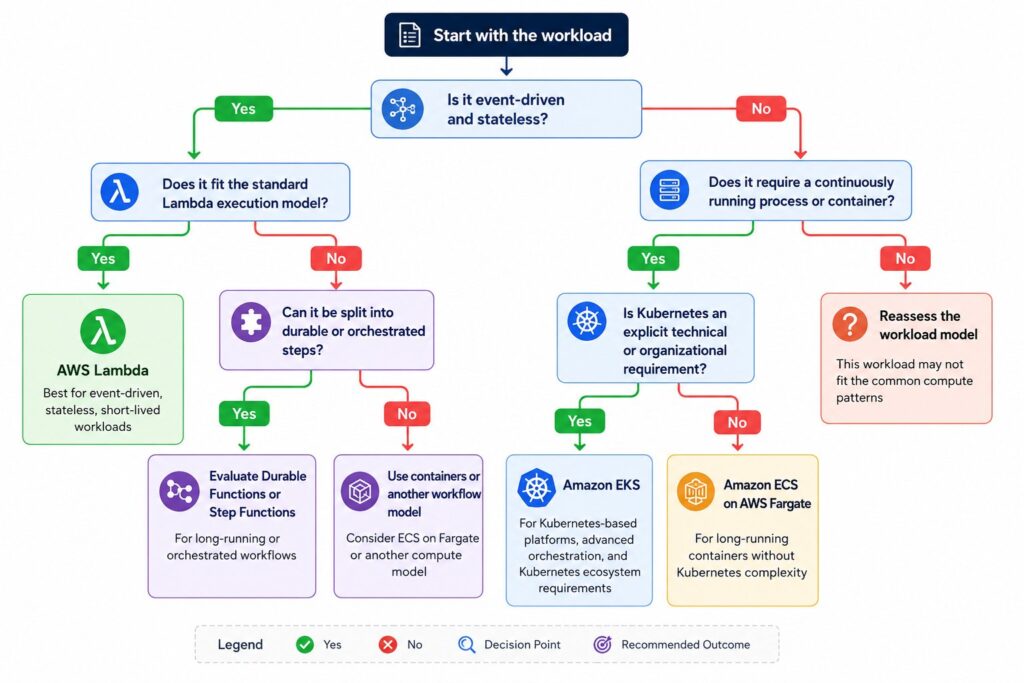
Architecture Decision Tree
Enterprise Decision Matrix
| Decision Factor | AWS Lambda | Amazon ECS on AWS Fargate | Amazon EKS |
|---|---|---|---|
| Primary abstraction | Function | Container task or service | Kubernetes workload |
| Strongest fit | Event-driven, stateless workloads | Long-running containerized services | Kubernetes platforms and complex container estates |
| Infrastructure overhead | Lowest | Low | Medium to high; reduced with EKS Auto Mode |
| Kubernetes required | No | No | Yes |
| Container image model | Packaging format within the Lambda execution model | Native container task or service | Native Kubernetes container workload |
| Continuously running services | Not the standard model | Excellent fit | Excellent fit |
| Event-driven workloads | Excellent fit | Good fit | Good fit |
| Scaling unit | Invocation and concurrency | ECS task | Pod and node |
| Scale to zero | Native | Achievable through service or event-driven scaling design | Achievable through workload and node autoscaling |
| Networking flexibility | Managed, with optional VPC access | Strong task-level VPC control | Highest flexibility, with added complexity |
| Runtime flexibility | Moderate | High | Highest |
| Portability | Lower | Medium | Highest at the Kubernetes API level |
| Operational skill requirement | Low to medium | Medium | High |
| Platform engineering requirement | Usually low | Low to medium | High |
| Migration effort for traditional applications | High when significant redesign is required | Low to medium for container-ready applications | Medium to high unless already Kubernetes-based |
| Strong default use case | Events and automation | Enterprise APIs and long-running services | Shared Kubernetes platforms |
Cost and Total Ownership
A meaningful enterprise comparison must include more than runtime charges.
Evaluate:
- Compute and idle capacity
- Load balancers and data transfer
- Logging and observability
- Deployment tooling
- Platform engineering
- Upgrades and maintenance
- Troubleshooting and incident response
- Developer productivity
- Third-party tools and licensing
Lambda
Standard Lambda pricing is primarily based on request count and execution duration. This can be efficient for intermittent or bursty workloads because no continuously running service capacity is required. Costs should be modeled carefully for high-volume, long-duration, memory-intensive, or provisioned-concurrency workloads.
ECS on Fargate
Fargate pricing is based on configured vCPU, memory, task duration, and additional storage where applicable. Cost efficiency depends heavily on task sizing, utilization, minimum replica count, scaling quality, and availability requirements.
Amazon EKS
EKS costs include the cluster control plane, worker compute, storage, networking, load balancing, and observability. EKS Auto Mode also introduces a management charge for the compute it manages.
The most frequently overlooked EKS cost is operational: platform engineering, upgrades, policy administration, troubleshooting, developer enablement, and shared-platform ownership.
The least expensive service on a pricing page may not be the lowest-cost platform for the organization operating it.
Hybrid Architectures: You Do Not Have to Choose Only One
Large enterprises frequently use all three platforms.
                         Amazon API Gateway
                                │
                 ┌──────────────┴──────────────┐
                 │                             │
                 ▼                             ▼
          AWS Lambda                 Application Load Balancer
     Events and Automation                      │
                                                ▼
                                      ECS on AWS Fargate
                                 Long-Running Business Services
                                                │
                                                ▼
                                     Databases and Managed Services

Amazon EKS
    │
    └── Kubernetes-Based Platforms,
        Operators, Shared Platform Services,
        Advanced Scheduling, and ML Workloads
For example, an enterprise may use:
- Lambda for asynchronous events and automation
- ECS on Fargate for standard APIs and workers
- EKS for an existing Kubernetes data or platform estate
This preserves Kubernetes where it provides value without forcing simpler applications onto a more complex platform.
The enterprise standard should therefore be a decision framework—not a mandate that every workload use the same platform.
Real-World Enterprise Scenarios
Scenario 1: Event-Driven Document Processing
A customer uploads a document to Amazon S3. The application validates the document, extracts metadata, and stores the result in DynamoDB.
Recommended platform: AWS Lambda
Why: Event-driven, stateless, bursty, and short-lived, with native S3 integration.
Scenario 2: Java Business API
An enterprise is modernizing a Spring Boot application currently running on virtual machines. The service exposes APIs, maintains connection pools, and runs continuously.
Recommended platform: Amazon ECS on AWS Fargate
Why: It is container-compatible, continuously running, load-balanced, and does not require Kubernetes.
Scenario 3: Enterprise Kubernetes Platform
An organization operates hundreds of microservices with a dedicated platform engineering team, GitOps workflows, service-mesh requirements, custom operators, and established Kubernetes skills.
Recommended platform: Amazon EKS
Why: Kubernetes is an explicit platform requirement supported by the organization’s scale and operational maturity.
Common Architecture Mistakes
- Choosing EKS because Kubernetes is popular: Introduces platform complexity without a Kubernetes requirement.
- Moving every workload to Lambda: Forces persistent or monolithic workloads into an unsuitable execution model.
- Choosing based only on container packaging: Ignores lifecycle, orchestration, networking, and operations.
- Comparing only infrastructure charges: Excludes engineering, observability, maintenance, and troubleshooting.
- Ignoring team maturity: Creates reliability, security, and delivery risks.
- Mandating one platform for every workload: Forces simple and complex applications into the same operating model.
Enterprise Decision Principles
- Begin with workload behavior and runtime requirements—not service preference.
- Select the least complex platform that satisfies current and foreseeable needs.
- Treat operational ownership, team maturity, and governance as architecture constraints.
- Evaluate lifecycle cost rather than compute price alone.
- Standardize approved patterns while allowing hybrid architectures where they reduce complexity.
- Document the decision and reassessment triggers in an Architecture Decision Record.
An Architecture Decision Record should capture:
- Workload assumptions
- Decision factors
- Rejected alternatives
- Cost expectations
- Operational ownership
- Known limitations
- Conditions that would trigger reassessment
Conclusion
AWS Lambda, Amazon ECS on AWS Fargate, and Amazon EKS are not interchangeable compute services. Each provides a different balance of abstraction, control, portability, and operational responsibility.
Lambda is a strong choice for event-driven, stateless workloads. ECS on Fargate is often the most practical option for long-running containers that do not require Kubernetes. EKS is appropriate when Kubernetes capabilities, tooling, or organizational standardization provide clear business and technical value.
For most enterprises, the goal should not be to select one universal platform. It should be to establish a consistent framework that guides each workload toward the simplest platform capable of meeting its requirements.
The right platform is not the one with the most features. It is the one that delivers the required outcome with the least unnecessary complexity.
About the Author
Deepali Sonune is a DevOps engineer with 13+ years of industry experience. She has been developing high-performance DevOps solutions with stringent security and governance requirements in AWS for 10+ years. She also works with developers and IT to oversee code releases, combining an understanding of both engineering and programming.
 Linkedin